


For researchers and laboratory professionals evaluating tianeptine products, selecting the appropriate chemical variant is the most critical decision in setting up an experimental protocol.
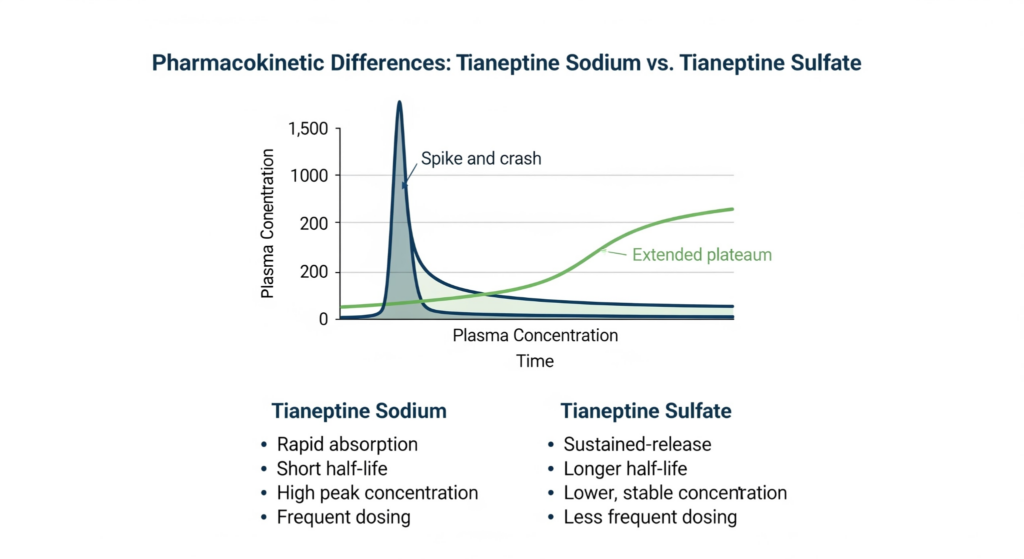
While both forms share the same core molecular structure and ultimately impact the central nervous system through glutamatergic modulation and neuroplasticity, their pharmacokinetics—how they are absorbed, metabolized, and cleared by a system—are fundamentally different.
The choice between Tianeptine Sodium and Tianeptine Sulfate comes down to a choice between rapid, short-acting acute effects and a smooth, sustained-release profile. This post will analyze the molecular differences, absorption rates, and practical research considerations of each to help determine which form aligns with specific experimental goals.
At their core, the primary difference between these two compounds lies in the salt molecule bound to the tianeptine base. This structural modification completely alters how the compound interacts with moisture, its stability, and how it dissolves in a solution.
Tianeptine Sodium is the classic salt form of the compound, heavily utilized in international clinical medicine for decades.
Tianeptine Sulfate was developed as a newer, modified alternative specifically designed to overcome the stability and rapid-clearance limitations of the sodium salt.
The structural differences between these two tianeptine products directly translate to how they behave over a timeline.
| Feature | Tianeptine Sodium | Tianeptine Sulfate |
|---|---|---|
| Moisture Sensitivity | Highly hygroscopic (absorbs water, clumps) | Stable, non-hygroscopic powder |
| Onset of Action | Rapid (30-60 minutes) | Gradual (1.5-3 hours) |
| Duration of Effect | Short (2-3 hours) | Extended (5-8 hours) |
| Dosing Frequency | Requires multiple frequent intervals | Typically a single, steady application |
| Risk of Misuse | High (due to rapid dopamine/opioid spikes) | Low (smooth curve, no sudden rush) |
| Storage Complexity | High (requires airtight desiccation) | Low (standard stable storage) |
When deciding which form to utilize in research, it is essential to consider the specific behavioral or neurochemical endpoints being measured.
The sodium variant is ideal for protocols studying acute, immediate neurochemical reactions.
If your research requires measuring immediate changes in glutamate receptor phosphorylation, rapid $\mu$-opioid receptor binding dynamics, or short-term behavioral responses to an immediate stimulus, the fast absorption of the sodium salt provides a precise, time-locked window of action. However, researchers must be prepared for meticulous storage requirements to prevent sample degradation from ambient humidity.
The sulfate variant is the preferred choice for protocols looking at long-term, steady-state effects.
If you are studying chronic administration, steady neuroplasticity improvements, prolonged BDNF upregulation, or stress-shielding effects over extended periods, the sulfate version is vastly superior. It eliminates the dramatic spikes and crashes, providing a smooth plateau of active compound. Additionally, its physical stability makes it far easier to weigh accurately and handle without specialized humidity-controlled equipment.
While evaluating these variants, it is vital to remain aware of the strict regulatory landscape surrounding all tianeptine products. Because the rapid absorption profile of Tianeptine Sodium can lead to recreational misuse, severe dependency, and acute withdrawal, the FDA has heavily cracked down on its distribution, clarifying that it cannot be marketed as a dietary supplement. Dozens of states have enacted complete bans on the compound.
Regardless of whether you choose sodium or sulfate, maintaining a strict stance on laboratory-only research and adhering to local legal compliance is mandatory.
The choice between Tianeptine Sodium and Tianeptine Sulfate is ultimately a choice between intensity and longevity. Sodium delivers a fast, sharp, short-lived peak, making it highly specialized and volatile. Sulfate delivers a controlled, extended, and stable baseline, making it the more predictable and manageable option for sustained research.
Bibliography